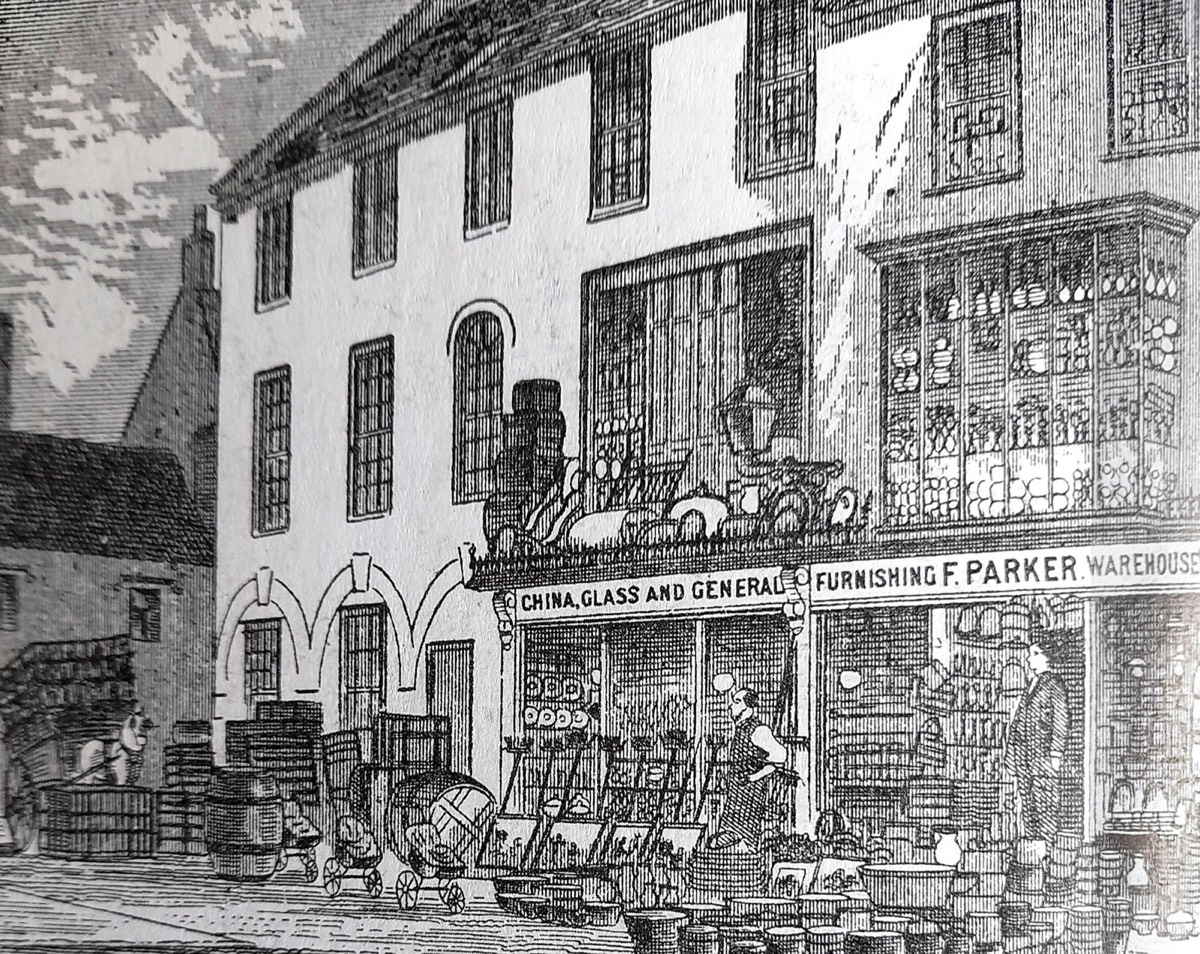
No. 10F. Parker’s furnishing warehouse. From the building’s archive.
A building’s history, told through its people. Research compiled by Len Ware.About this history ↓
16th century01 / 15
The building and the market square
10 Market Place stands in Shepton Mallet’s historic market square. The building’s history, researched and compiled by Len Ware, dates its origins to the sixteenth century.
The story becomes clearer in the nineteenth century, as records and memories introduce the shopkeepers, families and changing trades that made their home here.
A historic plan of Market Place, annotated to mark today’s No. 10. The date of the plan is not recorded.
182202 / 15
The earliest records
Pigot & Co.’s Business Directory lists Elizabeth Richardson as a dealer in china, glass and earthenware in Market Place.
Her exact premises remain uncertain. It has not been confirmed whether she occupied Nos. 9 and 10.
1845–184803 / 15
The Parker family
Francis Porch Parker is the first recorded occupier of 10 Market Place in the building’s history. He travelled the country with a dog-pulled cart, collecting marine merchandise, and expanded his business to include glass and earthenware.
In 1848, his son Frederick J. Parker succeeded him. Frederick also inherited responsibility for managing the market shambles.
A surviving advertisement presents Fred. J. Parker’s business as a wholesale and retail furnishing warehouse, with china, glass and earthenware, furniture available to order, and goods and cutlery offered for hire.
Advertisement for Fred. J. Parker’s furnishing warehouse. Its heading records the business as established in 1848.
1880s04 / 15
Trade and community life
Mrs Agnes Laver’s recollection of the shop in 1880 brings its everyday trade to life. Brown glazed salting pans, wash basins and jars stood on the pavement and road outside. Families salted butter in large brown jars to keep it for winter; she remembered it costing a shilling a pound.
Frederick Parker died during the 1880s. His obituary in the Shepton Mallet Journal remembered a generous, sympathetic supporter of local causes. He lent goods from his stock for school treats, tea meetings and other gatherings, saving the organisers trouble and worry.
The obituary also recorded his longstanding membership of the Oddfellows and his role in a Druid fraternal order, where he held the degree of Past Arch and was a member of the Grand Lodge of England.
An illustration of F. Parker’s china, glass and furnishing warehouse, with goods displayed outside. The illustration’s date is not recorded.
1920s–1930s05 / 15
China, glass and domestic ironmongery
Under Cornelius Pursey, No. 10 continued to sell china, glass and earthenware. Domestic ironmongery had joined the shop’s advertised range.
A surviving handwritten bill on C. Pursey’s Market Place letterhead offers a small glimpse of the business in 1926.
A handwritten bill on C. Pursey’s letterhead, 1926, advertising china, glass, earthenware and domestic ironmongery.
1930s–1970s06 / 15
Hooper’s shoe shop
John Edward Hooper, known as Jack, bought No. 10 and turned it into a shoe shop. The business continued through the following decades until the 1970s.
Jack’s daughter, Shepton Mallet resident Chloe Baker, remembers playing in boxes in the middle-floor offices as a small child.
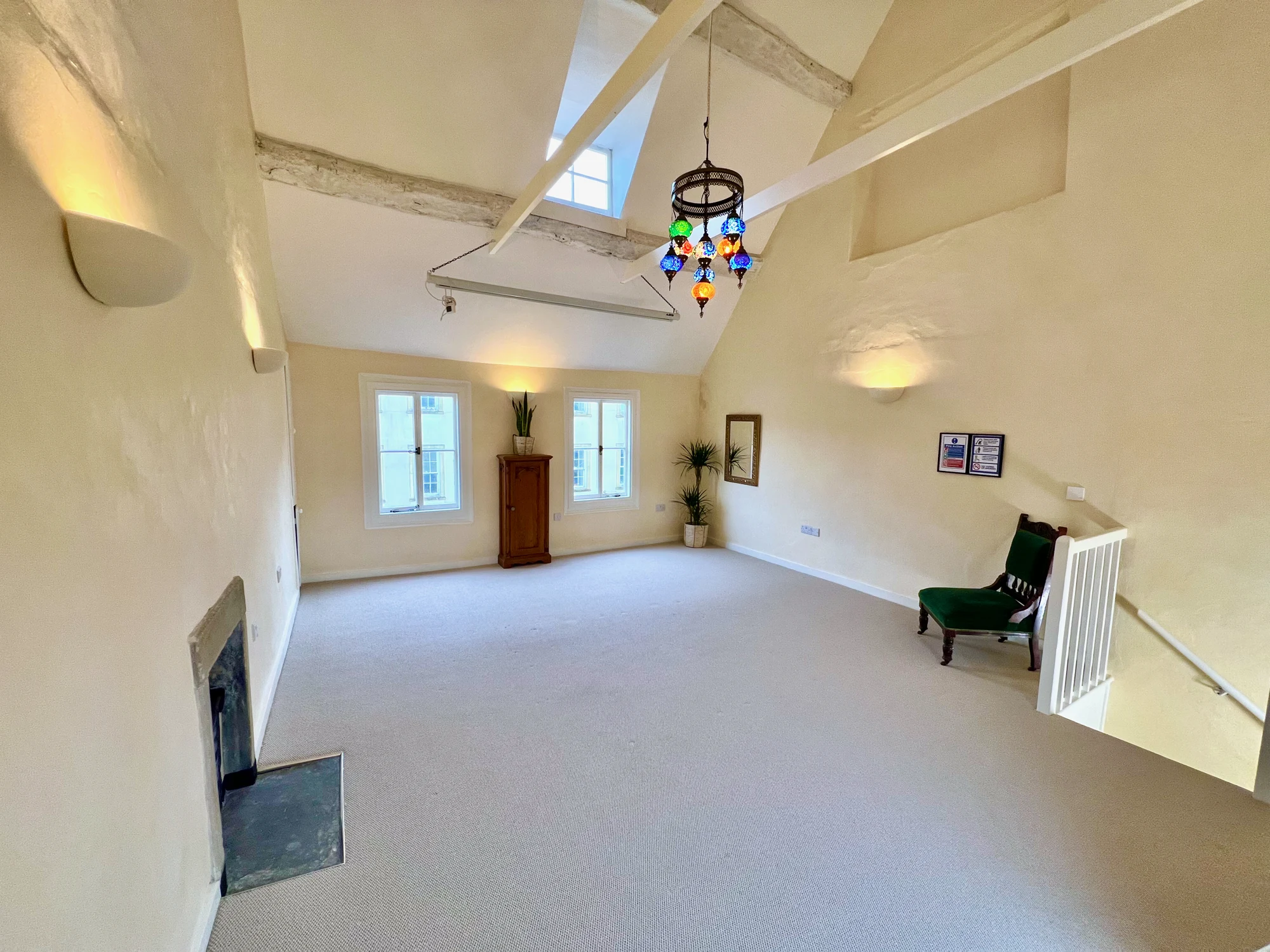
She also recalls her grandfather cobbling shoes at a sewing machine beside a top-floor window, looking out over the market square.
Chloe Baker, daughter of John Edward Hooper, whose memories help tell the building’s story.
J. E. Hooper’s shoe shop at No. 10, with footwear in the windows and Clarks and K Shoes signs above. The photograph’s date is not stated.
1970s07 / 15
A changing market square
Palmer Snell moved into the property, offering the services of chartered surveyors, auctioneers, estate agents and valuers.
Outside, the north-eastern block of the market square was demolished to make way for The Centre, a gift to the town from the Showering family.
Clearance and construction work beside Shepton Mallet’s market square.
1980s–1990s08 / 15
Coffee, clothes and needlecraft
The next years brought several changes. Dora’s Coffee Shop was followed by Ashton House, a dress shop and tea room selling Mandy Marsh dresses and jackets, alongside Sloggi underwear.
Mendip Needlecrafts then offered a range of tailoring services. The original account records Dora’s Coffee Shop again later, with a student menu and coffee from 70p.
The individual dates of these changes are not recorded, but together they show how often the shop adapted to the town around it.
The frontage of No. 10 during its time as Ashton House.
200409 / 15
Repair and regeneration
By 2004, the shop was in very poor condition. No. 10 became one of nine local properties to benefit from a Heritage and Economic Regeneration Scheme grant.
The building’s history credits Mendip District Council, Shepton Mallet Town Council and Somerset Council with securing the grant. It funded renovation and created a separate entrance to the offices above the shop.
201010 / 15
BBC’s Turn Back Time
The BBC chose Shepton Mallet for Turn Back Time, using empty shops to explore changing trades and shopping habits. The building’s history names 1887, 1914, the 1930s, the 1960s and the 1970s among the periods recreated.
Local residents were invited to take part. Families lived in the shops in period clothes, experiencing Victorian conditions with candles at night, chamber pots under the beds, and water fetched from the trough in the square.
No. 10 first became a Victorian dressmaker’s with fashion designer Gill Cockwell. For the 1960s, it became a hair salon, where Gill learned to create bouffant beehives.
The shop’s final role was a 1970s record store with music enthusiast David Lashmar. When the film crews left, No. 10 stood empty.
Cover artwork for the BBC series Turn Back Time: The High Street.
2011–202211 / 15
Biker clothing and Art of Essence
Barry Higgins brought his successful B.D. Biker Clothing business from Cheddar to No. 10. The shop traded until 2017, ending with Barry’s Ho Ho Ho Christmas pop-up.
From 2017 to 2022, naturopath retailer Art of Essence occupied the shop. A media outlet used the offices above.
A newspaper feature on Barry Higgins and B.D. Biker Clothing in Market Place.
September 202312 / 15
Interim Spaces takes on No. 10
Interim Spaces purchased 10 Market Place in September 2023. The charity planned a retail incubator in the shop and an affordable programme of music and wellbeing classes in the top-floor studio.
An interior window at No. 10, with exposed masonry below.
April 202413 / 15
The Little Farm Shed
The Little Farm Shed became the first participant in Interim Spaces’ retail incubator, opening at No. 10 in April 2024. The family business brought fresh produce and locally sourced food to the shop, with rent-free space, a capital grant and mentorship to help it establish itself on the high street.
In September 2024, The Little Farm Shed moved into its own commercially leased shop next door at 9 Market Place, completing the journey from an incubator placement to an independent shop.
The Little Farm Shed during its retail incubator placement at 10 Market Place.
202514 / 15
The Black Thistle
The Black Thistle followed as the next retail incubator participant in 2025, bringing houseplants, pots and botanical homeware to No. 10.
After its time in the incubator, the business moved to larger premises at 21 High Street, Shepton Mallet, where it continues today. Its move marks another step from a supported start at No. 10 to an independent home on the high street.
Ami at The Black Thistle during its retail incubator placement at 10 Market Place.
Today15 / 15
Nicolle Wilson Upholstery
Following the two retail incubator placements, the shop is now home to Nicolle Wilson Upholstery as a permanent tenant. Upholstery adds a new chapter to No. 10’s long history of independent trade and craft.
The studio programme continues upstairs, with classes and affordable space for local teachers and workshop organisers.
Nicolle Wilson working on an upholstered chaise at 10 Market Place.
About this history
We are grateful to Len Ware for researching and compiling the history of 10 Market Place. This account draws on the building’s original published history, including trade directories, advertisements, newspaper coverage and personal recollections. Interim Spaces has added the recent chapters on the retail incubator and the shop’s current tenant.
Where a detail or an image date is uncertain, we have kept that uncertainty visible. Select any archive image to see it in more detail.